“평화협정 체결, 대북교류, 신뢰구축, 이산가족 상봉”
Newsroh=로담爐談 newsroh@gmail.com
국제 여성평화운동단체인 '위민크로스 디엠지(Women Cross DMZ)’를 비롯, 미국의 평화운동단체들이 13일 민주·공화 양당의 대통령선거 후보 진영에 한반도의 평화와 비핵화를 진전시키는 정책을 채택할 것을 촉구했다.
이 단체들은 양 후보 진영에 보낸 ‘메모’를 통해 미국과 북한 간의 회담이 중단된 가운데 다가오는 대선이 향후 북미관계를 좌우할 것이라면서, 다음 정부가 잠재적으로 치명적일 수 있는 북미 긴장 고조를 피하기 위해 북한과의 관계 진전을 시급히 해야 할 책임이 있다고 강조했다.
또 이 단체들은 대선 후보들에게 북한에게 일방적인 군축을 요구하는 대신 비핵화에 대한 단계적 접근과 함께 구체적인 신뢰를 구축하고, 한인동포들의 북한 이산가족 상봉을 도우며, 북한과의 교류를 촉진하는 입장을 취할 것을 요구했다.
이 단체들은 특히 아직 진행 중인 한국전쟁을 공식적으로 종식(終熄)시키기 위해 평화협정을 체결을 요구하고, 이는 “북한과의 진정한 진전을 위해 군국주의와 긴장의 근본적 원인을 풀어야 하기 때문”이라고 주장했다. 이들은 차기 정부는 세계와의 교류에 엄청난 재량을 가질 것이라며, 후보들이 미국, 한국 및 세계 안보를 위해 평화와 외교를 우선시하는 데 그 힘을 사용할 것을 촉구했다.
이 ‘메모’에는 American Friends Service Committee, Arms Control Association, Beyond the Bomb, Center for International Policy, Foreign Policy for America, Friends Committee on National Legislation, Just Foreign Policy, Nuclear Age Peace Foundation, Peace Action, Quincy Institute for Responsible Statecraft, Win Without War, Women Cross DMZ, Women’s Action for New Directions (WAND) 등이 서명했다.
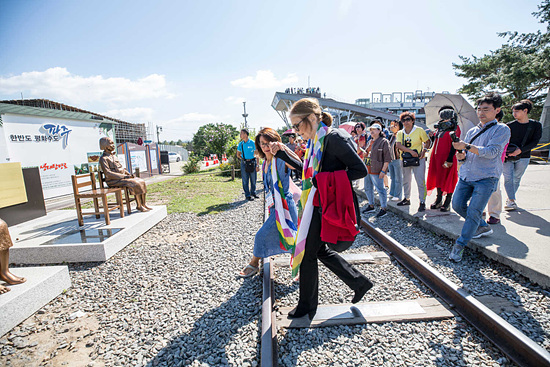
사진은 경기도 파주에서 경의선 철길을 상징적으로 건너는 여성운동가들 photo by womencrossdmz
아래는 각 단체 관계자들의 인터뷰 인용문.
“All of our security is at risk as our leaders are stuck in the past and clinging to failed policies of threats and war,” said Women Cross DMZ Executive Director Christine Ahn. “It is critical that the next administration be bold enough to change course by pursuing peace as a foundation for successful policy on the Korean peninsula.”
“Decades of experience have taught us that disengagement, ‘all or nothing’ demands and ‘maximum pressure’ campaigns can achieve little but miscommunication and mutual endangerment,” said Win Without War Executive Director Stephen Miles. “Only by choosing diplomacy can a next administration hope to build trust, denuclearization, and peace. Our security — the security of millions of people on both sides of the DMZ — depends on it.”
Kelsey Davenport, Director for Nonproliferation Policy, Arms Control Association, said, “An effective, sustainable diplomatic process stands the best chance of reducing the risk posed by North Korea’s nuclear weapons program and building peace on the peninsula. It’s critical that the next administration abandons unrealistic demands for unilateral denuclearization and puts incentives on the table to reciprocate tangible actions from Pyongyang.”
Daniel Jasper, Asia Public Education and Advocacy Coordinator, American Friends Service Committee, said, “For decades, the U.S. has been on a campaign to isolate and strangle North Korea into submission. This approach has failed miserably. North Korea’s nuclear weapons program is more advanced than ever, and sanctions have exacerbated already critical humanitarian situations. The next administration must, for the sake of national and global security, begin a process of step-by-step diplomacy, beginning with the most urgent human needs and building towards peace and denuclearization.”
Jessica Lee, Senior Research Fellow for East Asia at the Quincy Institute for Responsible Statecraft, said, “American taxpayers are tired of endless wars. Seventy years after the Korean War started, Washington and Pyongyang are still stuck in the past. We need serious, sustained diplomacy with North Korea with the aim of ending the war and achieving peace, not half-baked policies or kicking the can down the road.”
Colleen Moore, Digital Engagement Manager for Beyond the Bomb said, “Instead of spending billions of dollars on dangerous nuclear weapons, the United States must prioritize engagement with other countries and services that actually keep Americans safe. Especially in the midst of the global COVID-19 pandemic, it’s clear our priorities are in the wrong place. We encourage the U.S. to commit to bilateral No First Use commitments with North Korea and take steps toward peace on the Korean peninsula.”
“Neither ‘fire and fury’ nor photo-op summits will solve disagreements with North Korea,” noted Paul Kawika Martin, Peace Action’s Senior Director for Policy and Political Affairs. “The U.S. needs to work with regional countries and invest heavily in deep diplomatic work while easing sanctions that disproportionately affect innocents.”
“The stalled diplomacy with North Korea calls for a renewed effort to break the stalemate. This means working closely with our regional allies and putting forward realistic proposals, not all-or-nothing maximalist demands. Whoever is elected in November will need to address the situation on the Korean peninsula by prioritizing diplomacy and peace,” said Foreign Policy for America.

 뉴욕 :
뉴욕 :  파리 :
파리 :  서울 :
서울 :